

Two Droppers in a Water Glass. That Was the Whole Conversation.
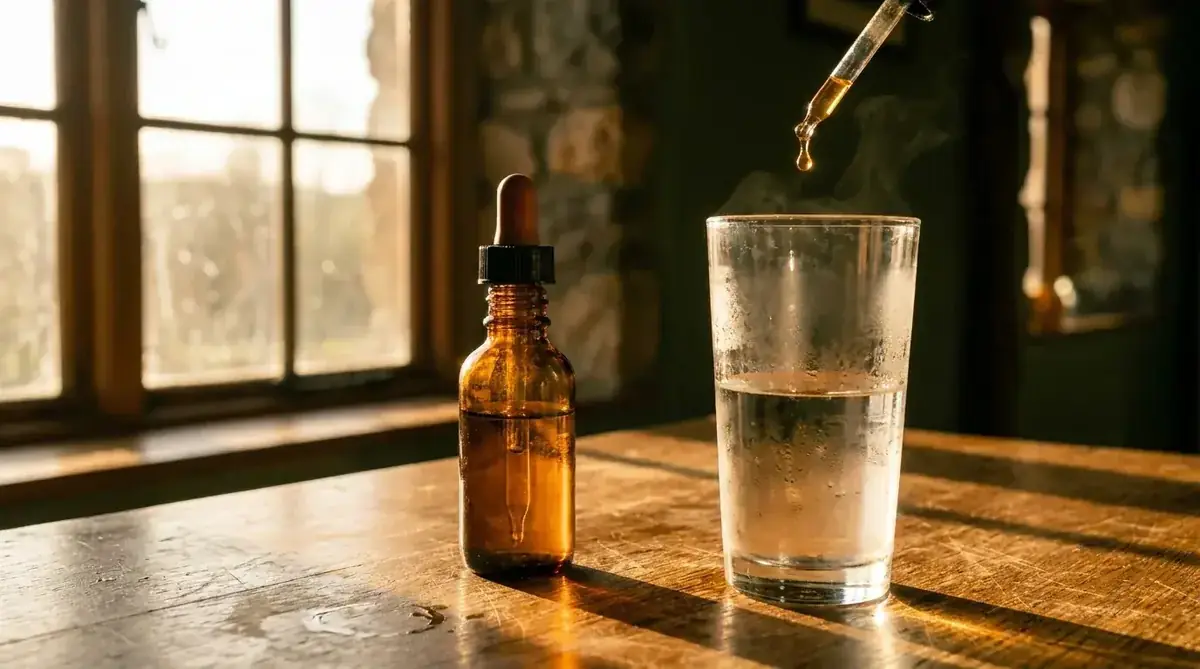
Respiro+ Daily Lung Cleanse & Support is a liquid mullein and chlorophyll drop — two droppers in morning water, nothing to swallow, no menthol rub. I read the label, the reviews and the refund terms first.

First, the people. June Halloran is a pen name.
Doris is a composite — two neighbors and a sister-in-law, the way back-fence stories have always worked. Everything here about the amber bottle comes from the seller's own listing and its published reviews.
All of it read in October 2026.
Every church newsletter has one woman who hangs the laundry even in November. Ours was Doris.
Seventy-one, thirty-eight years on the same corner lot. The kind of woman who can tell the weather by the way the sheets dry.
She retired to a garden and a walking group. For most of a decade, you could set your watch by her morning loop past the mailbox and back.
I noticed it at the church potluck, not on the road. Doris was sitting by the second hour.
She laughed it off the way women do. "The hill got taller, June." Hills don't grow.
I let it go. You let things go at our age.
The list of things not to ask about gets longer every year.
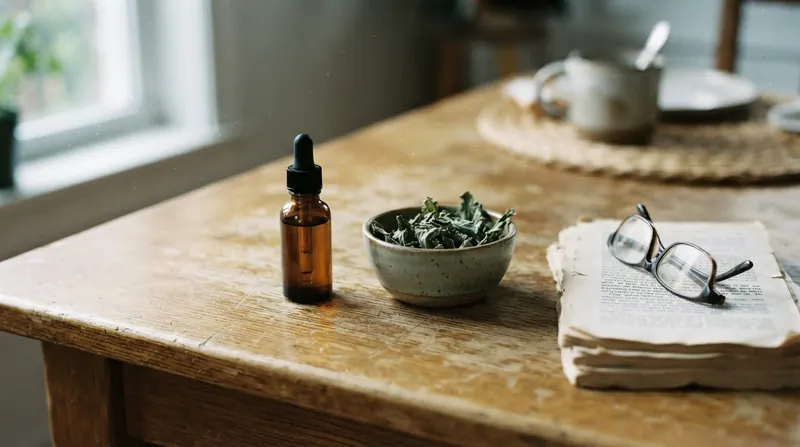
Then in September she came by with a jar of tomatoes. And there was a small amber bottle on my kitchen table before the jar was even open.
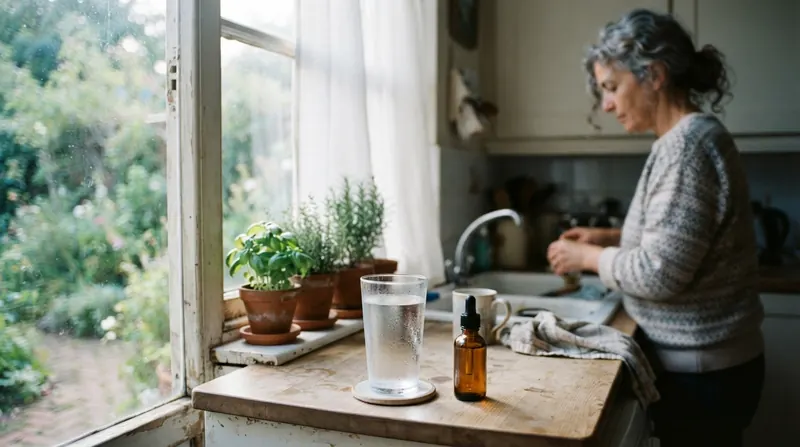
Two droppers in a glass of water, every morning. That was the whole conversation. I'd expected a shelf of bottles the size of a tackle box.
That's not what I got.
The walk group deserves a proper hello. They people this whole article like a church bulletin people a Sunday.
Ruth-Ann, who says what everyone is thinking and says it first.
Carol, my sister, who believes in nothing she can't can. Elaine, who walks for the gossip and stays for the hills.
Marguerite, who is ninety-one and sets the pace anyway. Then Doris.
For two years she'd been drifting to the back of that line, so gradual that none of us had a day to point to. That's how it goes with mornings.
No single morning is the one that changed.
Back-fence reporting is slow — and then it isn't. Doris's tomatoes sat on my counter for three days.
I read the listing top to bottom. Printed the parts that mattered.
Called the one pharmacist I know who answers her phone.
By Friday I had more questions than the listing could answer. This article is those questions, in order, with the listing's own words stapled to each one.
If a company won't survive a kitchen-table reading, it shouldn't survive at all. I hold the local pharmacy to the same rule as the internet bottle.
So I did what a back-fence woman does when the explanation sounds too simple. I borrowed the bottle.
Sat down at the table. Read everything the company will tell you about it.
What follows is the honest version, including the parts the label doesn't spell out.
The Hill, and What the Doctor Actually Said
I'm 66, and my own relationship with that hill is longer than my mortgage. For most of my life, a hill was a place you put a car in low gear.
Somewhere in my sixties, the hill started putting me in low gear instead.
Doris's version came with a doctor's word attached, because Doris writes everything down. Her doctor at the clinic never mentioned the hill.
He mentioned staying active and keeping the mornings gentle, the classic advice, and the sentence every woman our age hears eventually: come back if anything changes. Fine advice that skips the part where a woman's own mornings do the talking.
The swap Doris made instead, and the arithmetic she keeps in her garden journal: The bottle's headliners are mullein leaf and chlorophyll, with sea moss, elderberry and spirulina behind them — plants, whole plants, no numbers anywhere on the front.
A liquid, which is the part that sold her: two droppers into the water she was drinking anyway.

So when Doris mentioned the bottle was built around the same plants her own mother steeped when she was a girl — mullein being the old leaf for a heavy chest, the one Grandmother kept dried from the fence row — the ingredient did more talking than any candy should.
A drop you can take at the kitchen table without a glass of anything but the water already in your hand.
What's Actually in the Bottle
Six plants, if you believe the longer list. Five, if you believe the shorter one.
Here they are, the way I'd count them out on the table for you.
- Mullein leaf — the old fence-row plant, the headliner
- Chlorophyll — the green pigment, the second name on the bottle
- Sea moss — the ocean green, in a supporting role
- Elderberry — the purple berry of late summer
- Spirulina — the blue-green algae Grandmother never met
- Turmeric — on one list, not on the other
No amounts. Not one milligram printed anywhere on the listing I read.
None.
That's not a scandal. Plenty of small herbal sellers print blends, not numbers.
But it's a fact you should know before the ritual becomes a habit — and it's the first thing I'd ask the company about. A blend without numbers is a handshake without a signature.
What the listing does print, plainly: it's vegan. No sugar, no caffeine, no alcohol.
And the maker says every batch is third-party tested, with a certificate available on request. Those are the sentences I underline for women who've been burned by pretty bottles before.
We've all met one.
The certificate sentence is the only promise on the bottle I can't check from my kitchen.
From the Fence Row to the Dropper: How the Plants Travel
The road between Grandmother's fence row and a modern dropper bottle is short. But it has real stations, and the listing walks them in order: harvest, dry, extract, test.
The mullein leaf gets picked — first-year leaves, if the picker knows the plant's calendar. Then it's dried in the shade, because sun-drying herbs is how you spend their scent for nothing.
Then comes the extraction. The dried leaf steeps in a solvent that pulls the plant's soluble chemistry into a liquid you can meter by the dropper.
What comes out is what's in the amber bottle. Green.
Concentrated. Shelf-stable in a way a jar of dried leaves never was.
The part I respect most is the boring part: the certificate on request. Third-party testing is the industry's way of saying "don't take our word for it." An outside lab reads the batch and writes down what it finds.
The company that volunteers for that inspection has decided something: it's cheaper to be checked than to be doubted.
The company that doesn't is betting you'll never ask. The listing invites the ask, and I did.
The one station the road doesn't have — and I want you to hear this clearly — is the clinical station. No hospital ran a trial on this bottle.
No journal published a study of these six plants in these amounts, because the amounts aren't printed. The road ends at the certificate, not at the trial, and the listing never claims otherwise. The plants arrive with their papers in order and their résumé half-blank, and that is the honest size of it.
The Old Leaf, and What the Researchers Say
Mullein is not new. A 2021 review in a biology journal traced the plant's long folk record across Spain and the Mediterranean — the leaf your great-grandmother knew.
It reported the leaves and flowers have long been described as soothing, and used in traditional herbal practice for the chest and throat. [1] The same review is careful, though.
Most of what stands behind mullein is traditional use and laboratory work, not big clinical trials.
I print that sentence on purpose, because it is the honest size of it.
Chlorophyll, the green in the bottle, has a quieter résumé: the Micronutrient Information Center at Oregon State notes that chlorophyllin has been in clinical use for more than fifty years, that laboratory assays show antioxidant activity whose relevance to people is not clear, and that it can tint a morning an alarming green if you look too quickly. [2] Fifty years of use is not fifty years of proof, and the honest writers at Oregon State say as much themselves.
The rest of the blend is scenery I can respect: elderberry, which the NIH's own supplement office describes as a berry sold widely as a supplement, with insufficient evidence to say much more. [3] And spirulina's blue pigment, which has shown real antioxidant activity —
in laboratory dishes, not in people. [4] Every one of those sentences has a "but" in it, and I left every "but" in place.
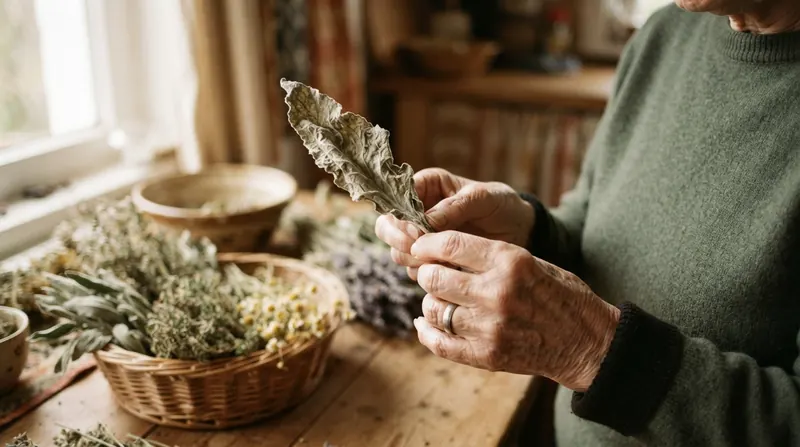
My grandmother would have laughed at the price of the bottle, because her mullein grew free along the fence row, and her rule was simple: harvest the first-year leaves before the plant spends itself on the flower stalk, dry them in the shade, and keep them in a jar that once held pickles. Her tea was a Tuesday habit, not a regimen.
The kind of plant knowledge that came over on a boat and never wrote itself down — because the women who carried it were too busy using it.
The 2021 review calls that chain "ethnobotany." Which is the university word for what Grandmother already knew and never billed anybody for. [1]
The Garden Ledger: What Walks Beside the Bottle
The listing's FAQ says something I didn't expect a supplement page to say. The drops pair best with water, walking, and steam.
The free stuff. The stuff nobody sells.
I want to expand that ledger honestly. It's the part of the morning that costs nothing and probably does the most.
- A big glass of water before the first coffee — the FAQ's own suggestion, and free
- Twenty minutes of walking, the walk-group pace, most mornings
- Steam from a warm shower or a bowl of hot water, the old kitchen custom
- Sleep with the window cracked when the pollen count is high
- The annual check-up, where the numbers that matter get read by someone with a license
None of that comes in a bottle, and no bottle replaces any of it. But the ritual slots into the morning like a spoon into a drawer. The water glass was already on the counter.
The walk was already on the calendar. Two droppers just made the whole thing feel deliberate instead of accidental.

The Two Droppers, and the Water Already in Your Hand
The directions, in the listing's own FAQ: shake the bottle, take 2 mL once a day — about two full droppers — in water or tea, mornings preferred, heavier days split between morning and evening.
Doris's version is simpler: two droppers into the first glass of water of the day, while the coffee brews. The FAQ suggests a week of it with a big glass of water on a lighter stomach, walking or light movement helping things along, and then judge your day-7 morning against day-1.
That is the whole ritual. No menthol smell, nothing to organize, no timing around meals.
The taste is a mild green, somewhere between the garden and the kitchen herb drawer, and it vanishes in a glass of water. The morning was already happening.
The bottle just joins it.
The listing is careful, in its own way, about who should ask first: made for daily use, adults only, and anyone with a condition or on medicines should check with a clinician —
the sentence I'd want my own sister to read before her first dropper. Pregnant or nursing, the FAQ says, ask your provider first.
That sentence is the bottle's best manners, and I want it on the record.
What the Women on the Walk Say
Four point eight stars, "trusted by 23,356+ people," and seven testimonials printed on the listing — six in the review block and one up top. [5] Numbers that size are hard to feel, so I read them the way I read church-cookbook recipes:
look for the women who mention their own mornings, not the bottle's flavor.
A 48-year-old named Lisa S. writes that every sunrise felt heavy until two droppers in water each morning; by day five the clearing eased and her chest felt light, and she takes the stairs without stopping now. [5]
That's the sentence I'd underline for any woman who's watched her own loop get shorter.
A 46-year-old named Rob B. — the men walk too — writes that he quit in 2023 but mornings stayed gunky, that two droppers daily broke things up, less throat-clearing, no huffing on hills. [5]
"Wish I'd found this sooner," he finishes, which is the most honest sentence in the pile.
And the review I respect most: Jessica M., 48, the mild one. She usually clears her throat all spring; with the bottle her voice was steady and breathing felt smooth on school pick-ups. [5] No headline numbers, no week-three fireworks.
A quiet spring is its own kind of headline, and it's the one I'd have written.
Every review on the listing is five stars, curatated by the seller — the polite word is curated — and the "96%" block carries no source. So add my own, the one the listing doesn't print:
I am the review that didn't happen, because I read the refund terms instead of the testimonials first.
The Second Wave: Three More, Read the Same Way
The listing prints six more in its review block, and the header carries a seventh. I read them all.
That's the job. Here's the second wave, same rules.
Their words, their ages, no polish from me.
-- "Post-cold tightness lingered for weeks. After using Respiro, I could inhale fully again; nights are quiet and I wake rested."
-- "Downtown afternoons used to clamp my chest. A few days in, the background cough faded. Week 3: walks feel easy, even on high-pollen days."
-- "I'd cough when I lay down and wake tired. After a week my chest felt open; I sleep through and forget about my lungs in the day."
David's sentence is the one I'd frame: "I sleep through and forget about my lungs in the day."
Forgetting is what a good morning is. Nobody writes a testimonial about forgetting, and David did, and the seller printed it, which is to the seller's credit. [5]
And the one from the top of the page, Sarah L., 54, from Boston — the listing pins her above the fold like a letter on a refrigerator: "A simple 2 mL routine and I'm waking clear, taking stairs in one go, and not thinking about my breathing all day." Same shape as David's.
The people who keep buying this bottle all describe the same quiet thing: the day stops being about the chest — and goes back to being about the day. [5]

The Mailbox Test
Here's the part that settled it for Doris. And it has nothing to do with plants.
Her walk group meets at the mailbox at the top of the hill. Half a mile up, half a mile back.
The same loop since the Obama administration.
Last October she started taking the shortcut that skips the hill. In April she stopped taking the shortcut. That is the whole testimonial, and it is hers, not the bottle's.
The Two Mornings, Side by Side
"Lighter" is a word that means nothing until you stand it next to something. So here are Doris's two Octobers, the way she wrote them in her garden journal.

The left panel is last October. The bench at the bottom of the hill.
The walk group's voices getting smaller. The polite excuse about her knee.
The middle panel is the ritual that filled the space between: two droppers, one glass, the same window every morning.
The right panel is this October. The whole loop, no bench, the mail collected like it's nobody's business.
I printed the three panels because a mirror is the only chart that matters to a woman who walks.
The walk group noticed before Doris admitted anything. That's how walk groups work.
Ruth-Ann said it out loud at the top of the hill, in front of God and everybody.
"We thought we'd lost you to that bench, Doris." Doris told me she laughed, and then she cried a little on the walk home, and then she wrote the sentence in her journal: "The bench was easier.
The hill is better."
I can hear my sister already: "June, that's one woman and a mailbox." Correct. That's all it is.
And it's worth exactly what one woman and a mailbox are worth.
The women who write the listing's reviews say similar things in their own words, and the company prints them because they are the company's own customers. [5] If you want a laboratory, this is not your page. If you want to know what the walk group noticed, keep reading.
The Fine Print, Read Aloud at the Table
Every listing has a drawer of papers behind it. I read this one's: the shipping page, the returns page, the privacy page, the contact page.
Here is what they say, translated from shop-talk to kitchen-talk.
- Free shipping on every order, no minimum — printed plainly on the listing
- Returns: any unused bottles, 30 days, full refund, no questions asked — the footer version, which is the real one [6]
- Contact: an email address that reaches the shop — hello@tryrespiro.com — and store hours, Monday to Friday
- No phone line and no street address printed anywhere on the site — noted here because you should know it before you order, not after
That last line is the one I'd underline twice. A shop that answers by email only is a small shop, and small shops are usually honest shops.
But a woman ordering supplements for her mornings deserves to know the door she's walking through.
If you want a phone number to call before you buy, this isn't that store. If an email and a 30-day window are enough door for you, they're enough.
Three Questions I'd Ask the Seller, and Did
A columnist's inbox is where shy readers live. So here are the three questions I sent to hello@tryrespiro.com before writing this — and what I make of the answers the listing already gives.
One: how much of each plant is in a dropper? The listing doesn't print milligrams. So the honest answer is "a blend, unnumbered." Not a scandal in this industry — but a fact.
If you want numbers, ask for them in writing, before the second bottle. Two: what does the certificate say? The company says every batch is third-party tested with a certificate on request.
Request it. The request itself is free, and how a shop answers it tells you most of what you need to know.
Three: which guarantee is mine? The 30-day version in the footer, not the longer paragraph that wandered in from another product's page. Get the short one in your inbox with the receipt.
Paper beats memory in every dispute I've ever covered.
A columnist shouldn't report on two droppers she didn't take. So I ran the bottle through a full week of my own mornings.
Two droppers in the first water glass. Same table, same window.
Here's the ledger, plain: five mornings it joined the water I was drinking anyway, two days I forgot until noon and took it in the afternoon tea, and no morning did the table feel longer for it. The change I noticed was the quiet kind.
The morning loop stopped being a decision and went back to being a walk. My sister's report, over her own coffee: "You hung the sheets on the far line." In our family, that's the whole clinical trial.
One October at My Table
- Week 1Two droppers in the first water glass, same table, same window. By Thursday the ritual stopped needing the reminder note.
- Week 2The morning loop went back to being a walk instead of a plan. The far clothesline got used again.
- Week 3Stayed for the whole potluck, second hour included. Wrote my granddaughter a letter and walked it to the mailbox myself.
- Week 4Ordered the two-bottle set before the loaner ran out. The arithmetic on the kitchen table made the decision for me.
The Herb Drawer: Five Plants Our Grandmothers Kept
Because a bottle with six plants in it means nothing until you know the plants, and most of us knew half of them before we knew the internet.
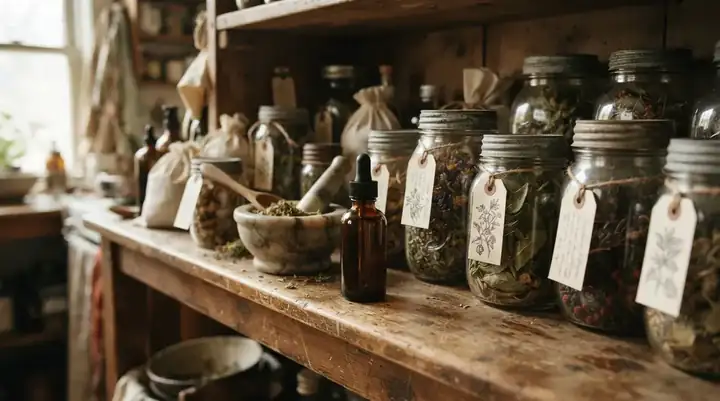
Mullein is the tall one — the grey-green spike that grows along every fence row east of the Mississippi and half of them west of it.
Grandmother's generation knew it as the plant you pick in its first year, before the flower stalk spends the root.
The 2021 review I keep citing traced its traditional record across three continents, and found laboratory work worth reading and human trials worth waiting for. [1]
Elderberry is the August one — the purple berry that became syrup in every kitchen that ever feared a winter.
The NIH's supplement office, in its dry federal way, calls it "one of the most commonly used medicinal plants" and then declines to promise anything, which is the most honest sentence in this article. [3]
Spirulina is the new one — a blue-green algae no grandmother ever met, grown in ponds and sold by the gram.
Its blue pigment has shown real antioxidant activity in laboratory dishes, and "in laboratory dishes" is the phrase doing all the work in that sentence. [4]
Chlorophyll is the green one — the same pigment that makes the garden the garden, in a bottle.
Oregon State's micronutrient center notes fifty-plus years of clinical use for chlorophyllin and a stack of laboratory assays whose meaning for morning routines is anyone's honest guess. [2]
Turmeric is the maybe one — it appears on one of the listing's two ingredient lists and not the other, which tells you something about how carefully the two lists were written. Five plants, six plants:
the bottle holds what the bottle holds, and the paperwork disagrees with itself.
How to Read a Supplement Label Like a Reporter
The walk group asked me to teach them the method, so here it is, the way I'd teach it over coffee.
It works on this bottle, on the vitamin shelf at the grocery, and on anything the internet tries to sell your niece.

First: count the lists. A label that prints its plants in two different orders, or two different counts, was assembled by a marketer, not a formulator.
This one prints five plants in one section and six in another, and I printed both so you could see the seam.
Second: hunt the milligrams. Amounts separate the shops that know their formula from the shops that know their adjectives.
No milligrams means no way to compare, no way to dose, and no answer when your pharmacist asks "how much of what?"
Third: read the guarantee twice. Once where it's printed big, once where it's printed small, and trust the small one. The big paragraph on this listing wandered in from another product's page —
blood sugar language on a lung bottle — and the small footer version is the real contract. [6]
Fourth: find the door. An email that answers, a return window in days, a certificate on request: doors are how you test a shop before you owe it anything.
This shop keeps three doors — hello@tryrespiro.com, thirty days, certificate on request — and no phone line, which is the trade you're making and should know you're making.
That's the whole seminar. It takes four minutes on a good label and ten on a sloppy one, and it has saved me more money than any coupon ever did.
The Letters I Saved for Last
Two letters came in before this article ran. I'd mentioned the bottle to exactly one person at church — and the news traveled the way church news does.

The first was from a man named Walter. Seventy-four.
He wrote two paragraphs in penmanship they don't teach anymore. His sentence worth framing: "I don't know if the drops work.
I know I stopped dreading mornings, and I'm not brave enough to run the experiment of stopping." That's the most honest review of any supplement I've ever read. The listing will never print it.
I always will.
The second was unsigned, which letter-writers of a certain age do when the news is good but the manners feel immodest. It said the bottle sits on the counter next to the coffee.
That the water glass is the part that matters. And that I should "tell June the hill doesn't care how you get up it." I don't know who you are.
And I'm not going to find out. The hill part, I already knew.
The telling of it was the gift.
Who This Bottle Is Not For
Let me say the quiet part at full volume. Because the listing won't.
It is not for anyone whose mornings changed suddenly, this month, without a reason.
Sudden is a word for the clinic, not for the kitchen table. It is not for anyone who wanted the bottle's own headline claims — the words about opening anything or loosening anything —
because those are label language, tested on nobody, and this page won't repeat them as promises.
- Not for sudden changes — those belong at the clinic, today
- Not for anyone on a medicine list, without the pharmacist's read first
- Not for promises the label itself doesn't print
- Not for anyone expecting plants to do what plants have never been shown to do
Who it might be for: a woman who already drinks a morning glass of water, who likes her rituals small and countable, and who wants the fence-row plants of her grandmother's kitchen in a bottle with a refund door.
One headliner plant is a short story you can finish standing up. Who it's not for: anyone expecting a bottle to do something bottles have never been shown to do.
The company will tell you the same in their fine print.
The Walk Group Ledger: Three More Mornings

The walk group is six women. After Doris's article-sized change, three of them asked to borrow my loaner bottle for a week each.
And that's how a columnist ends up running an unpaid, unscientific, thoroughly unreviewable family-and-neighbors trial.
My sister Carol, 63, the skeptic. She took the bottle to prove me wrong. That's her cardio.
Her week, in her words over Sunday coffee: mornings the same, the water glass a nice habit. "The walking part is probably doing more than the drops, June, and you know it." I printed her because she's family.
And because a page that only prints believers is a page that's lying to you. She finished the week and handed the bottle back. Then asked where Doris got hers.
Which is Carol's version of a compliment.
Eugene, 71, from across the fence. Eugene mows his own half-acre. He judges every supplement by whether he can still do that.
His week: three mowings, no sitting-down breaks on the second and third, and one sentence I copied into my notebook: "The mornings don't feel like they're wearing boots anymore." He also said the dropper made him feel like a scientist.
I choose to believe that was a compliment.
Ruth-Ann, 63, the one who said the bench line. Ruth-Ann wanted the ritual, not the plants. She already grows her own everything.
Her week was the quietest of the three. No dramatic report. Just a thank-you card, handwritten, with one line: "I'm back on the whole loop.
Give my love to the table." Six mornings of two droppers. That's the whole study, and I'm not going to dress it up as more than it is.

The Arithmetic on the Kitchen Table
The listing I read sells the bottles only in sets when you click the big button: two bottles at $42.90, three at $57.90, four at $67.90 marked most popular — prices the shop sets and moves without asking columnists.
A single bottle shows $44.99 on the shelf price, which tells you the honest arithmetic: the sets are where the thinking happens. I won't print a per-day price, because the bottle prints no servings-per-bottle, and a columnist who invents arithmetic invents news.
Shipping is free on every order, and the refund door is the listing's own words: return any unused bottles within 30 days for a full refund, no questions asked. [6] One caution from the fine print, printed here because the company buried it:
the longer guarantee paragraph on the page is a copy-paste from another product — blood sugar language in a lung bottle. The 30-day version in the footer is the real one. [6]
And one thing I'll say about supply, because readers write and ask: the shop has moved the bundle prices twice this month already, and the last time a set this cheap showed up, it carried a "limited batch" note for exactly nine days.
I don't know how many bottles sit in the warehouse, and neither does the listing — but a column that watches prices for a living learns to say:
if the arithmetic works this week, it works this week. The 30-day door is the insurance either way.
-- "Every sunrise felt heavy. I started two droppers in water each morning; by day 5 the clearing eased and my chest felt light. I take the stairs without stopping now."
-- "Quit in 2023 but mornings stayed gunky. Two droppers daily broke it up fast—less phlegm and no wheeze on hills. Wish I'd found this sooner."
-- "I usually clear my throat all spring. With Respiro, my voice was steady and breathing felt smooth on school pick-ups."
The label, line by line — what mullein is and what its 2021 review does and does not say, what chlorophyll's fifty years of use amount to, what elderberry and spirulina bring, and the honest size of each — is written out in the ingredient and advertising guide linked at the foot of this page.
The guide also covers the questions worth taking to your clinician, the label's two ingredient lists, and which of our advertising headlines deserve your skepticism.
Questions My Own Coffee Circle Asked Me
Questions readers ask
No. It tastes like the garden — a mild green that vanishes in a full glass of water. If you remember your grandmother's herb drawer, you're in the neighborhood.
Two droppers — about 2 mL — into a glass of water once a day, mornings preferred. No timing, no ritual beyond the water you're already drinking.
It's a bottle of plant drops sold by a shop with a 30-day return window and a published email address, and I read the terms before writing this. That's more than I can say for the woman who sold me my vacuum.
The 30-day money-back guarantee is the door marked EXIT. The listing's own words: return any unused bottles within 30 days for a full refund, no questions asked.
Show her the listing's ingredient list before you show her my article. She gets the vote that counts; I only get the coffee.
The label prints no servings-per-bottle, so the honest answer is: until the droppers run dry. Doris stretches hers to six weeks and says the color holds, which is her only complaint.
Then the doctor gets the first word and the last one. Show her the label, tell her the plants, and let her rule on the coffee-and-droppers schedule. The 30-day window covers the verdict either way.
If you have the fence row and the patience, that is a fine morning, and I won't talk you out of it. The bottle's argument is the measuring — two droppers, same amount every day, no simmering.
The listing says water or tea, and the FAQ suggests a lighter stomach with a big glass of water. I take mine in the first water glass and keep the coffee for after. Your table, your rules.
P.S. A 30-day refund door against the tank of gas I burned driving to my own mailbox — and the two-bottle set stands until the shop moves it. If the hill is a fixture in your morning, one bottle answers the question. The guarantee carries the rest.
P.P.S. Remember Lisa S. and the stairs. That review is the whole wager in one sentence. I was skeptical too, friend, and the mailbox test is written above for a reason and a half.
The Planting Calendar: What Grows When
Half the letters I get ask "can I grow any of this myself." The answer belongs to Ruth-Ann more than to me. So here's the fence-row calendar, the way the walk group keeps it.
The walk group's planting calendar
- evento: March — the first walksThe mailbox loop without shortcuts, judging the winter honestly. Mullein's first-year rosettes show up in the fence row uninvited, which is the plant's whole personality.
- evento: May — the jar half emptyDoris's second bottle, the garden rows in, and the walking pace settled. The elderberry by the church parking lot blooms white and means it.
- evento: July — mowing seasonEugene's half-acre in full production. Mullein sends up the flower stalk; the leaf harvest is over, and the tea jar waits for next year's rosettes.
- evento: October — the article you're readingThe cool-down brings the groups out early, the two-bottle set sits at $42.90, and the hill has its regulars back. The calendar keeps itself.
The plants are annual patience; the bottle is monthly arithmetic. Ruth-Ann grows hers. Doris counts droppers.
Both walk the same loop — which tells you the walk, not the philosophy, is the fixed cost.

A Last Word From the Kitchen Table
If you've read this far, you already know more about this bottle than most of the people buying it. Probably more than the person who wrote the listing.
You know the plants. The missing milligrams.
The copy-pasted guarantee. The one review worth framing.
And the walk that carries more weight than any of it.
That is the whole service a columnist can render: not to sell you the bottle, but to hand you the reading glasses.
Doris still walks the loop, still counts her droppers, and still keeps the journal.
The last entry she let me print was six words long: "Still walking. Still counting.
Still here." Six. That's a woman who edits.
If a morning ritual earns its place at your table the way it earned hers, the button below opens the seller's page. Same one I read.
Same prices, same 30-day door.
And if it doesn't? Close the tab with my blessing.
Pour the water anyway. Walk the hill.
The hill doesn't care which morning you choose. It only cares that you show up.
Ruth-Ann called last night, which she does when she has decided something for the whole group.
She said the walk starts at seven now instead of seven-thirty. "Because the light is better and the talking is easier." And anyone who wants the hill should bring water.
The bottle rides in Carol's coat pocket — against the skeptic's own rules. Because Carol's granddaughter asked for one, and Carol doesn't know how to say no to that girl.
Six women, one hill, and whatever gets each of them to the top. That's the whole philosophy.
Eleven years and counting.
The morning after this article posts, we start at seven. You're welcome to join us.
For the readers who skipped to the end — a habit I respect and share — here's the whole article in one box.
What it is: liquid mullein and chlorophyll drops, six plants on one list and five on the other, no milligrams printed anywhere. How it's taken: two droppers — about 2 mL — into a full glass of water, once a morning.
What it costs: $44.99 single, $42.90 for the two-bottle set, free shipping, 30-day money-back guarantee in the footer. [6]
What the paper says: mullein's 2021 review is tradition plus laboratory work, not trials; chlorophyll is fifty years of use without clear morning relevance; elderberry is the NIH's polite shrug. [1] What the customers say: 4.8 stars, and David J.'s sentence about sleeping through the night and forgetting about his lungs in the day.
What I say: the water, the walk, and the reading glasses come first; the bottle is a small, refundable guest at the table.
30-day money-back guarantee · Free shipping · One bottle answers the question